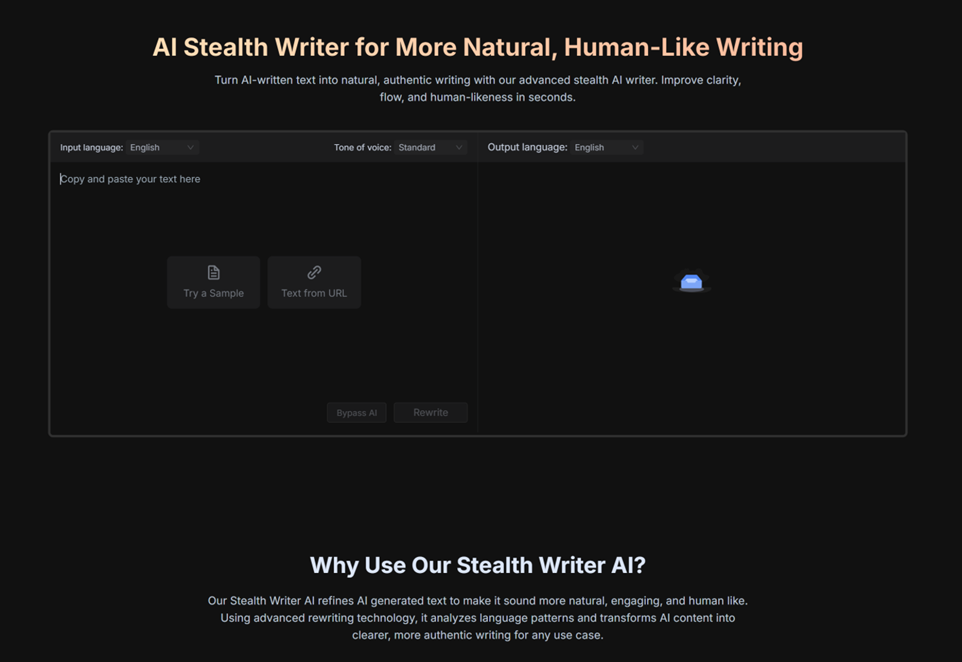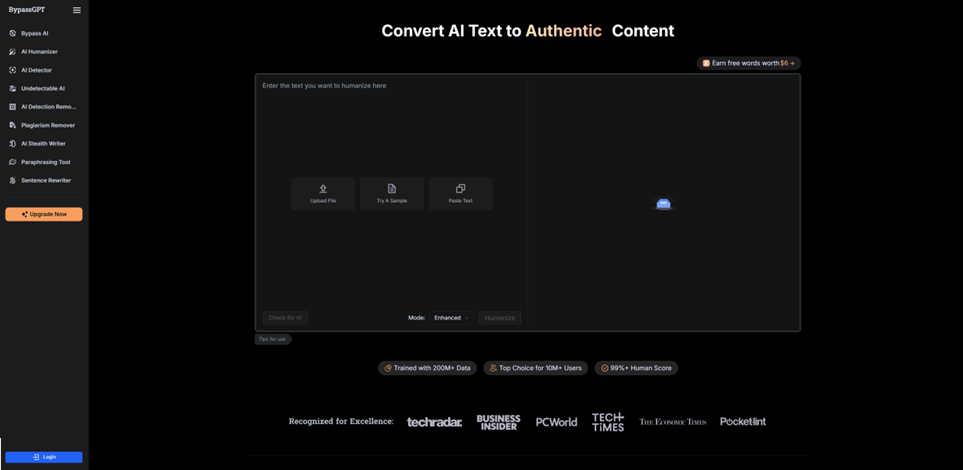
As financial institutions and publicly traded corporations increasingly integrate generative artificial intelligence into their communications, the line between algorithmic efficiency and investor trust has become a critical strategic battleground. While automated text generation offers unprecedented operational leverage, market regulators and corporate analysts are paying closer attention to the risks associated with overly synthetic corporate messaging. To safeguard brand equity and maintain authentic engagement across investor channels, forward-thinking enterprises are adopting advanced naturalization solutions, such as an AI Stealth Writer, to refine raw data outputs into nuanced, human-sounding narratives. In this evolving digital asset ecosystem, platforms like bypassgpt play an essential role by transforming rigid automated text into fluid, undetectable prose that meets the rigorous disclosure and engagement standards of modern capital markets.
In the financial sector, where reputation directly correlates with market valuation, communication is never merely administrative it is a core business asset. Over the past two years, the rapid adoption of Large Language Models (LLMs) allowed corporate relations, marketing, and analytical teams to scale written output by orders of magnitude. However, market participants have quickly grown sensitive to the telltale signs of unrefined AI writing: repetitive syntax, emotional detachment, and predictable phrasing. When financial reports, market commentary, or shareholder updates display these characteristics, stakeholder trust wanes. Investors instinctively associate generic, machine-written text with a lack of diligence or genuine executive oversight, introducing unnecessary headline risk to institutional brands.
Beyond investor perception, search engine architecture presents a tangible operational hurdle for financial publishers and fintech platforms. Search algorithms have implemented stringent filters aimed at identifying mass-produced, low-value synthetic content, particularly within YMYL ("Your Money Your Life") categories. Content that relies on default LLM outputs frequently lacks the E-E-A-T (Experience, Expertise, Authoritativeness, Trustworthiness) criteria required for top-tier search visibility. When corporate insights or financial analyses are flagged as automated spam, search engine rankings plunge, directly eroding organic distribution and customer acquisition strategies. To maintain domain authority, corporate publishing teams must ensure that every piece of digital collateral exhibits the structural variance and cognitive depth characteristic of seasoned financial analysts.
Bridging the gap between raw data generation and market-grade communication requires a fundamental shift in editorial technology. Simple proofreading or basic keyword adjustments are insufficient to strip away the underlying mathematical patterns of generative models. Natural human writing in high-stakes industries features complex structural dynamics—varying sentence lengths, strategic vocabulary shifts, and context-aware pacing that guides the reader through intricate economic arguments. Advanced text refinement systems operate by dismantling the predictable, high-probability word sequences of standard AI, replacing them with dynamic phrasing that mirrors human reasoning. This transformation elevates raw drafts into polished, authoritative market commentary that resonates with sophisticated investors while seamlessly bypassing automated content filters.
Looking ahead, the competitive advantage in corporate communications will not belong to organizations that generate the highest volume of text, but to those that achieve the highest quality of engagement. As generative tools become standard infrastructure across global markets, the ability to maintain a distinct, authentic corporate voice will serve as a key differentiator for public and private companies alike. C-suite executives and communications directors must view text naturalization not as a superficial cosmetic layer, but as a vital component of enterprise risk management. By embedding sophisticated linguistic refinement into their publishing pipelines, businesses can continue to leverage the speed and scale of artificial intelligence while preserving the credibility, investor trust, and market influence that sustain long-term enterprise value.