
A competitor’s product page shows a lower price in one country than another. Before a business changes its pricing strategy, it needs to know what explains the difference: a local promotion, a tax adjustment, a different seller, or a genuinely lower offer. Providers such as Socks5.IO supply infrastructure for collecting geographically targeted public web data, but the commercial value comes from comparing the right observations under consistent conditions.
A residential proxy routes a request through an IP address associated with a residential internet connection. For market intelligence teams, that can help reveal how publicly available prices, product listings, and other content vary by location. It does not automatically make the resulting dataset accurate, representative, or suitable for a business decision.
The practical question is therefore broader than which proxy to buy. Businesses need to decide what to measure, which locations to observe, how to preserve session consistency, and what each usable record costs. Those choices determine whether a collection project produces dependable market intelligence or an expensive spreadsheet of misleading comparisons.
What Role Do Residential Proxies Play in Market Intelligence?
Market intelligence is information about customers, competitors, products, and market conditions that helps a business make decisions. Public websites provide some of that information through product prices, availability notices, promotions, store listings, and published service offers.
Residential proxies sit within the collection process. They influence where a request appears to originate, allowing a team to examine location-dependent content when the target website uses IP geolocation.
They do not select the research sample, interpret the content, or establish that an observation is correct.
A useful workflow looks like this:
Research question → Source selection → Data collection → Validation → Analysis → Business decision
Proxy infrastructure supports the collection stage. Problems elsewhere in the workflow still matter. A perfectly delivered request cannot fix an incorrect product match or a sample that excludes important competitors.
Where an authorized API, licensed feed, or downloadable dataset provides the required information, evaluate it first. Those sources may offer clearer usage rights, structured fields, and lower maintenance costs.
Four Practical Uses for Residential Proxies
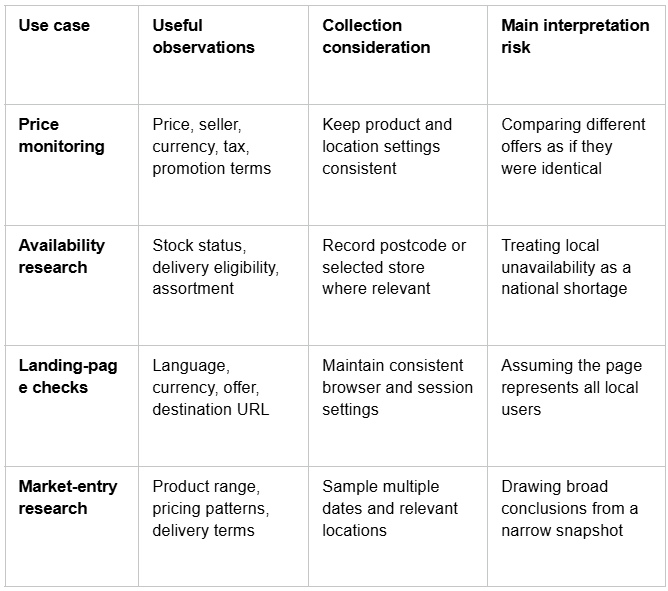
1. Competitor Price Monitoring
Retailers and manufacturers often need to understand how their products are priced across different markets. A national price comparison may hide regional promotions, seller differences, and delivery charges.
Geographically targeted collection can help answer questions such as:
Is a competitor discounting the same product in selected markets?
Does the advertised price include tax?
Is a promotion available to all visitors or only members?
Does the lowest-priced seller actually have stock?
A useful price record includes more than the number displayed beside a product. Capture the product identifier, seller, currency, availability, promotion conditions, location context, and observation time.
Otherwise, a members-only offer can be mistaken for a market-wide price cut.
2. Product Availability and Assortment Research
Price matters less when a product cannot be delivered.
Businesses can monitor public availability signals to understand which products competitors carry, where assortment differs, and when listings move in or out of stock. These observations can support merchandising and distribution research.
Interpretation requires care. “Unavailable for delivery to this postcode” does not establish that a product is unavailable nationally. Similarly, a missing listing may reflect a website change rather than a discontinued product.
Residential proxies can support regional observations, but delivery location often needs to be set explicitly through the website’s own controls.
3. Localized Advertising and Landing-Page Checks
Marketing teams can examine publicly accessible landing pages from different locations to check whether campaign destinations display the expected language, currency, offer, and legal information.
For example, a campaign intended for French customers might lead to a page that defaults to another market’s pricing. A location-aware check can identify that mismatch before it affects a larger campaign.
The boundary matters: viewing a landing page from a regional IP does not prove that an advertisement was shown to a representative local audience. Ad delivery also depends on platform targeting, account history, consent settings, and other signals.
Avoid generating artificial clicks or treating automated page visits as evidence of genuine consumer exposure.
4. Cross-Border Market Research
Before entering a new market, a business may compare competitors’ product ranges, delivery promises, public pricing, and promotional schedules.
Repeated observations are usually more informative than a single snapshot. A low price captured during a holiday sale may not represent the normal competitive environment.
A research plan should therefore specify both geography and time: which locations will be sampled, how often, and for how long. Residential proxies help provide location-based access; the sampling plan determines what conclusions the business can reasonably draw.
Why Location Alone Does Not Guarantee Comparable Data
An IP address is only one input a website may use to decide what a visitor sees.
Other inputs include:
Delivery postcode or selected store.
Account status and membership.
Cookies and previous visits.
Browser language and currency preferences.
Device type.
Experiment or personalization assignments.
This creates an important distinction between accessing a page from a location and reproducing a defined customer scenario.
For comparable research, document a standard scenario. For example: logged-out visitor, desktop browser, specified delivery postcode, local currency, and no membership discounts.
Keep those conditions stable between observations. When a condition cannot be controlled, record the limitation rather than silently treating the results as equivalent.
Rotating or Sticky Sessions: Which Should You Use?
Rotating sessions change the exit IP according to the provider’s configuration. Sticky sessions attempt to retain the same exit IP for a defined period.
Neither option is universally better.
Rotation can be useful for separate observations across a distributed collection task. Sticky sessions are useful when several requests belong to one coherent browsing sequence, such as selecting a location and then opening several product pages.
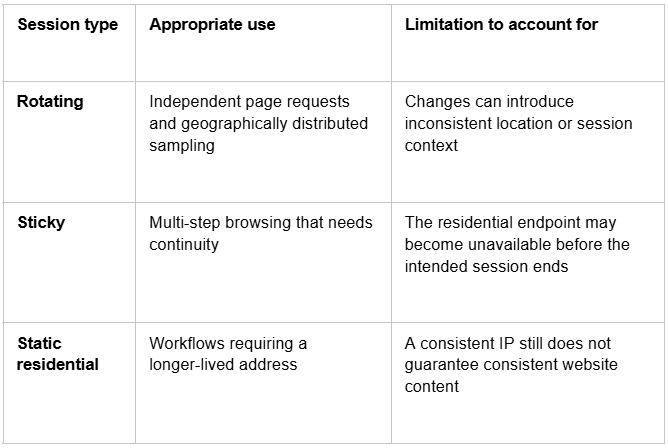
Sticky sessions should be paired with consistent cookies and location settings. Retaining an IP while resetting the rest of the browsing context does not necessarily preserve the same experience.
Socks5.IO’s published residential offering includes both automatic rotation and sticky sessions. The practical benefit is the ability to match session behavior to the task: independent observations can use one approach, while connected browsing steps use another. Teams should confirm session-duration rules and endpoint behavior before relying on them in production.
How to Calculate the Real Cost of Market Data
The advertised price per gigabyte is a purchasing metric. It is not a complete measure of research cost.
A collection project may also incur spending on browser infrastructure, failed requests, retries, parsing, data storage, monitoring, and analyst review.
A more useful measure is:
Cost per usable record = Total collection and processing cost ÷ Number of valid, usable records
Define “usable” before measuring it. For a pricing project, a record might need a confirmed product match, timestamp, location context, valid currency, and a price that passes basic checks.
Consider this hypothetical comparison:
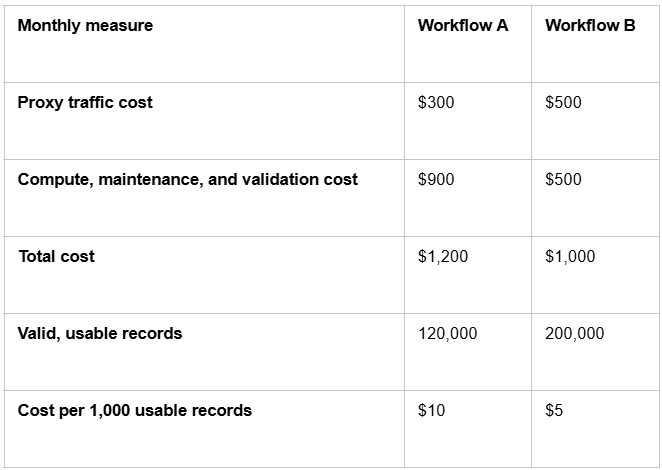
These figures illustrate the calculation; they are not provider benchmarks.
Workflow B spends more on proxy traffic but less overall per usable record. That could happen because it requires fewer retries, less browser processing, or less manual correction. The cause needs to be measured rather than assumed.
Other useful metrics include:
Usable-record rate: usable records divided by attempted observations.
Freshness: elapsed time between observation and availability for analysis.
Coverage: completed observations across the planned products, sources, and locations.
Retry overhead: traffic and processing spent repeating unsuccessful collection.
Maintenance effort: time spent correcting broken extraction rules.
Report these metrics by source and location. A healthy overall average can conceal a failing market segment.
Where Socks5.IO Fits in a Business Collection Workflow
According to its published product information, Socks5.IO offers residential coverage across more than 190 countries and regions, geographic targeting that includes supported state and city selections, rotating and sticky sessions, and HTTP(S) and SOCKS5 connectivity.
For a market intelligence team, those features have specific uses.
Geographic targeting supports a defined research sample. A business can request relevant markets rather than collect from arbitrary locations. Coverage claims should still be checked against the exact countries and cities required.
Session controls support different collection patterns. Teams can preserve context for connected browsing steps or use rotation where observations are independent.
Protocol support helps with integration. Existing browsers, collection clients, and network tools differ in what they support. Having both HTTP(S) and SOCKS5 options can simplify compatibility, although protocol choice alone does not determine data quality.
Usage-based billing supports bounded pilots. A team can measure traffic consumption and usable-record cost before committing to a larger workload. Bundle pricing should be assessed alongside expiry periods and realistic consumption.
Socks5.IO also publishes integration examples for common programming languages and tools. That documentation can help engineers establish an initial connection, but a successful connection is only the first acceptance test.
A meaningful pilot should verify actual regional availability, session continuity, error behavior, and usable data yield on the intended sources. Provider-published network figures describe the offering; they are not independent evidence of performance on every website.
A Data Quality Checklist Before Results Reach Decision-Makers
Confirm That Products Are Truly Comparable
Match by stable identifiers where possible, such as GTIN, UPC, or manufacturer part number. Titles alone can confuse different sizes, bundles, generations, or refurbished products.
If matching remains uncertain, assign a confidence level and exclude weak matches from automated pricing decisions.
Preserve the Price Context
Store the original currency and distinguish product price from shipping, tax, deposits, and conditional discounts.
If converting currencies, record the exchange-rate source and date. A currency movement can otherwise look like a competitor’s price change.
Record Time and Location
Every observation should carry a timestamp and the relevant location settings.
Separate the collection time from any publication or update date shown on the page. They answer different questions.
Identify Missing Data Explicitly
A timeout, an access-denied page, and an out-of-stock product are different outcomes.
Do not convert failed requests into zero prices or unavailable inventory. Record a status that explains why the expected data is missing.
Review Unusual Changes
Large price movements, sudden inventory collapses, and abrupt changes in product counts deserve checks before being reported as commercial events.
A website redesign or parser error can create the same pattern as a major business change.
Retain an Audit Trail
Where permitted, preserve source URLs, collection parameters, extraction versions, and enough supporting evidence to investigate anomalies.
An analyst should be able to explain where a number came from and which assumptions shaped it.
Responsible Collection Is Part of Reliability
Public availability does not automatically authorize every form of collection or reuse. Review source terms, applicable laws, licensing requirements, and the nature of the information being gathered.
Use reasonable request rates, avoid private or account-restricted information without authorization, and minimize personal data. Ask residential proxy providers how their network participants are informed and how participation is authorized.
These decisions also affect business continuity. A research process that depends on unauthorized access or an unclear data supply chain creates operational risk, even if its initial results look useful.
Frequently Asked Questions
Are residential proxies necessary for market intelligence?
No. They are useful when location-dependent access is relevant to the research. An authorized API, licensed dataset, direct website access, or datacenter proxy may be sufficient for other tasks. Choose the simplest suitable collection method.
Do residential proxies guarantee accurate local prices?
No. They provide an IP-based location signal. Delivery addresses, cookies, account status, taxes, and promotion eligibility can also affect the displayed price. Accurate comparisons require controlled settings and contextual records.
What is the difference between residential and datacenter proxies?
Residential proxies use exit addresses associated with residential internet connections. Datacenter proxies use addresses hosted in datacenter networks. The appropriate choice depends on location requirements, source behavior, cost, and performance measured during a pilot.
Should a pricing project use rotating or sticky sessions?
Use sticky sessions when several requests need to preserve the same browsing context. Rotation can suit independent observations. The important requirement is consistent, documented conditions for each comparison.
How should a business compare proxy providers?
Test providers against the same sources, locations, schedule, and validation rules. Compare usable-record cost, geographic coverage, session behavior, latency, support, and network-sourcing transparency. Avoid choosing solely by advertised pool size or the lowest headline price.
Can public web data predict a company’s financial performance?
It can contribute evidence, but it is not a direct substitute for financial reporting. Listed prices and availability do not reveal completed transactions, margins, returns, or total demand. Any financial interpretation needs additional evidence and a clear account of sampling limitations.
What should a first collection pilot measure?
Start with a bounded set of sources, products, and locations. Measure coverage, freshness, usable-record rate, total cost, and analyst review effort. Expand only after the dataset answers the original research question reliably.
Reliable market intelligence begins with a well-defined observation. Residential proxies can help businesses make those observations across locations, while tools such as Socks5.IO provide targeting and session controls for the collection process. The value comes from what follows: comparable records, transparent costs, and conclusions that remain within the evidence.